Buying in Mount Airy? Check Which Train Line the House Is On
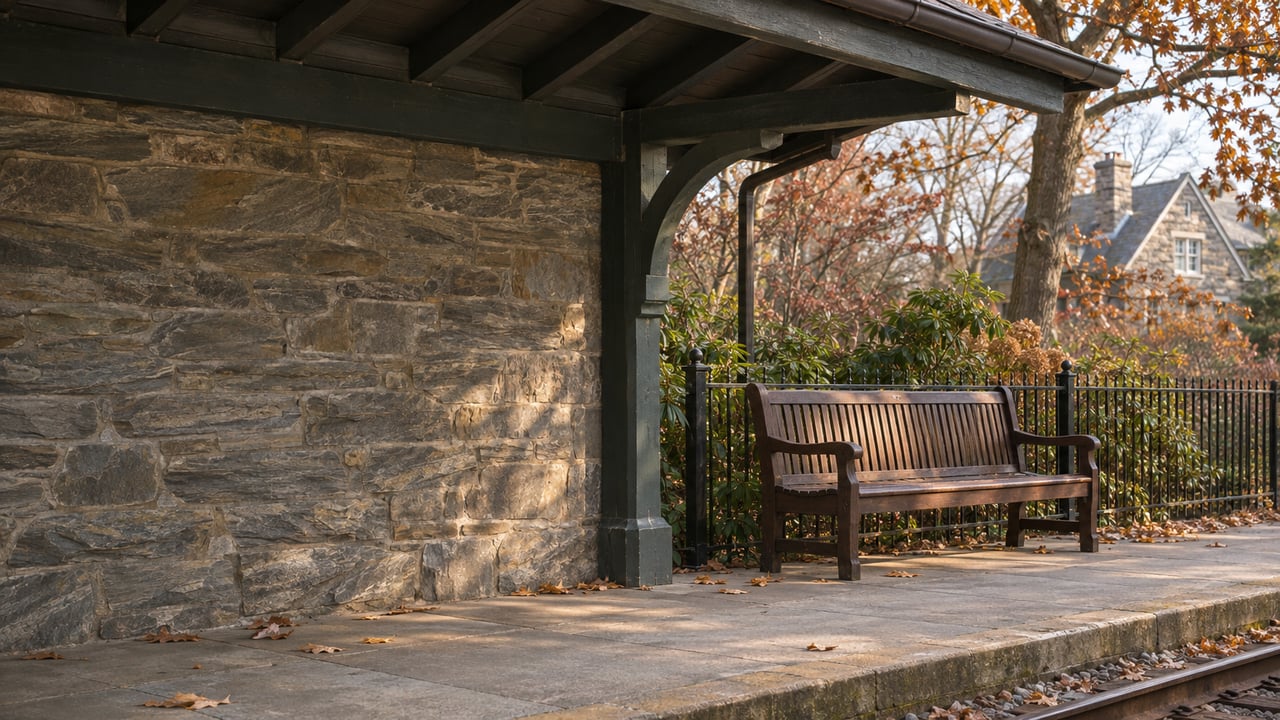
West Mount Airy's Carpenter and Upsal stations sit on one Regional Rail line, and East Mount Airy's Sedgwick and Mount Airy stations sit on another, a few blocks apart on either side of Germantown Avenue. The weekday timetables for the two lines look almost the same. On paper, SEPTA has already given the two Mount Airy lines very different futures.
For a buyer weighing West Mount Airy against East Mount Airy, that changes a question most guides answer in one line. Both sides have "Regional Rail access." Those are two different lines, though, and the agency's long-range plan treats them very differently.
Today the service is close to equal. SEPTA's current Chestnut Hill West timetable, effective July 5, 2026, has 21 weekday departures in each direction, and the Chestnut Hill East timetable, effective October 18, 2026, has 20 weekday departures toward Center City and 21 in the other direction. West line trains run mostly hourly after an early-morning pair. East line gaps vary more, from roughly 30 minutes at some points to more than an hour at others, with extra early and peak trips.
Greg Smith, a West Mt. Airy Neighbors board member and Save the Train volunteer, worked through the West line's weekday schedule in an October 22 op-ed in the Chestnut Hill Local. He found that from the first morning departure to the last evening one, trains leave an average of about 52 minutes apart.
That's why buyers rarely tell the two lines apart. A house near Upsal and a house near Sedgwick both come with a train about once an hour.
On September 22, 2026, SEPTA announced Accelerate, a decade-scale vision tied to a formal bid for 230 Silverliner VI rail cars. The agency said those cars would support service every 15 minutes or better at nearly half of its roughly 150 stations. Chestnut Hill East is named among the lines targeted for 15-minute service. Chestnut Hill West is not.
The detail is in SEPTA's Regional Rail Master Plan. In its long-term Network Vision, Chestnut Hill East is paired with the Wawa line as the "S2" line, with ridership forecast to grow 212% over 2019 levels and daily departures rising to 1.75 times 2019 weekday levels and nearly three times 2019 weekend levels. The plan pairs the two lines because they have "similar ridership potential" and link "walkable, mixed-use communities."
Chestnut Hill West gets a single line in the same document: "60-minute, all-day service throughout the line," because ridership modeling "affirmed the logic" of keeping it hourly, "as this line offers duplicative service."
The timeline matters here. The plan's early-action phase calls for 60-minute all-day service on both Chestnut Hill lines. The 15-minute East line is a long-range goal, not a schedule anyone will ride next year. Still, it shows where SEPTA would put new service if it had the money, and in Mount Airy that's east of Germantown Avenue.
Smith's op-ed answers the "duplicative" label with a question of its own: "Duplicative to whom?" He writes that the East and West lines come close together in parts of Chestnut Hill but "elsewhere they serve different streets and different walks," and he names the walk from western Mt. Airy to Upsal, Carpenter or Richard Allen Lane. West Mt. Airy Neighbors reported in January 2024 that the West line carried more than 1,700 weekday riders.
Chestnut Hill West has been on a cut list before. In May 2025, SEPTA proposed a 45% service reduction and a 21.5% fare increase to close a recurring $213 million deficit, with five Regional Rail lines, Chestnut Hill West among them, set for elimination on January 1 if no funding arrived.
That cut never happened. The Inquirer reported on August 29, 2025, that a Philadelphia judge had halted the planned Regional Rail cuts, and a September 4 order required SEPTA to reverse the cuts already made. On September 8, 2025, Gov. Josh Shapiro approved SEPTA's use of up to $394 million in capital assistance for operations, which the state said would preserve service for two years.
This fiscal year runs on the second and final year of that money. SEPTA's FY2027 budget, adopted June 25, 2026, keeps service levels and fares unchanged. It also reports a $192 million structural operating deficit. As of November 11, the Chestnut Hill Local reported that SEPTA had identified Chestnut Hill West as likely one of the first Regional Rail cuts if funding gaps persist.
The November 3 election gave Democrats control of the state Senate, which sets up a Democratic trifecta in Harrisburg starting in January 2027. In the same Local article, Bob Previdi, policy director for Save the Train, said SEPTA has "clearly expressed a vision" and "it just needs investment to make it attractive to run frequently," while state Sen. Art Haywood described a multi-year approach to closing the gap. That makes recurring funding more possible than it was. It hasn't been passed.
Econsult Solutions put numbers on transit access in a November 2018 study for SEPTA built on more than 313,000 arm's-length Philadelphia home sales from 2000 to 2018. Over that period, a 10-point increase in a home's transit score went with a 5.8% higher single-family sale price, all else equal. Across the city, Econsult estimated the SEPTA-access premium in single-family homes at an average of $25,700 per house. That score blends every transit mode, not only Regional Rail. The study still makes the basic point that a house price includes the trains near it.
The same premium can shrink. In April 2025, WHYY reported an Econsult scenario in which homes within three miles of the five lines then facing elimination, including Chestnut Hill West, could lose nearly $20 billion in value together. That's a regional figure covering five lines, not a forecast for any one Mount Airy block.
The Inquirer's 2018 coverage of the same research said suburban premiums ran larger near stations with more lines and more peak trains. Frequency is part of what a buyer pays for. If SEPTA's long-range plan happens, the train frequency on the East side goes up while the West side stays hourly at best.
The two sides of Mount Airy have different housing. West Mount Airy's Pelham section was developed in the 1890s with ties to Wendell & Smith and architects including Horace Trumbauer and Charles B. Keen. It has wide, curving streets and large lots, and most of its houses went up between 1893 and 1910. On the East side, development of the Gowen estate produced more than 200 houses and twins between 1885 and 1906. East Mount Airy is mostly twins and rowhouses on a tighter grid. West Mount Airy has more detached singles on deeper lots sloping toward the Wissahickon, and it generally sells for more.
For years, a walk to Upsal, Carpenter or Allen Lane has been part of what you got with a West side house. SEPTA's plan doesn't take that walk away, but it does change its odds. A West Mount Airy buyer who commutes by rail is paying for hourly service that will last only as long as the state funds it. An East Mount Airy buyer near the Chestnut Hill East stations is buying onto the line the plan wants to make frequent someday.
If you drive to work or work from home, none of this matters much. If you plan to ride the train for years, it matters more than any single comp. Pick the house you love on either side, and know which line it's on.
Some changes near the stations are already done. SEPTA's first new bus network phase, reported in August 2026, extended Route 53 from Wayne Avenue and Carpenter Lane to Carpenter station. ReAnimator Coffee opened at 6509 Germantown Ave. on July 3, 2026, between Upsal Street and Gorgas Lane.
Two larger projects were last reported as plans. Ken Weinstein's Philly Office Retail holds a SEPTA lease at $1 a year for up to 99 years on the station buildings at Mt. Airy, Carpenter, Upsal, Tulpehocken and Gravers. As of the Local's September 2025 report, the plan was commercial space downstairs with housing above at four of them, and a likely food use at Upsal. On the East side, TierView Development's 81-unit building with 2,734 square feet of commercial space at 6903–6915 Germantown Ave., between Gorgas Lane and Sedgwick Street, received a Zoning Board special exception for heritage-tree removal on October 29, 2025.
If you're still deciding between the two sides, our Mt. Airy neighborhood guide and our post on choosing between Mt. Airy and Chestnut Hill cover the rest of the comparison.
Is Chestnut Hill West closing? No. The line is running on a timetable effective July 5, 2026, and SEPTA's FY2027 budget keeps current service levels. The Local reported in November that SEPTA sees it as a likely early cut if funding gaps persist.
Will East Mount Airy get 15-minute trains soon? No. The 15-minute target is part of the long-range Network Vision. The Master Plan's early-action phase calls for hourly all-day service on both Chestnut Hill lines.
Which stations are on which line? Upsal, Tulpehocken, Carpenter and Allen Lane are on Chestnut Hill West. Washington Lane, Stenton, Sedgwick and Mount Airy are on Chestnut Hill East.
If the train is part of how you plan to live in Mount Airy, The Liz Clark Real Estate Team can walk the station routes on both sides of Germantown Avenue with you and look at the houses along each one before you write an offer. Let's Meet.
Stay up to date on the latest real estate trends.
From Scheduling a Home Inspection to the Final Report.
A Walking Guide to Galleries, Gardens, and Historic Landmarks.
A Practical Plan for When Inspections Turn Up Surprises.
On Inspections, Financing, and Appraisal Protections.
If you’re thinking about selling your home, obsessively scrolling for a house, planning a relocation to the area, or just feel unsure where to start, we can help. Reach out for a zero-pressure 30-minute phone or video meeting to get started. We are here to listen, support, and educate so you can feel confident with your decisions in our swiftly moving market